
Why a crisis in the Gulf pushes up the price of plastic sheet
Published on: 17/03/2026
Oil prices hit $126 a barrel last week. If you're wondering what that has to do with the cost of a polycarbonate or acrylic sheet — the answer is: everything. Here's why, and what we're doing about it.
Plastic starts life as crude oil
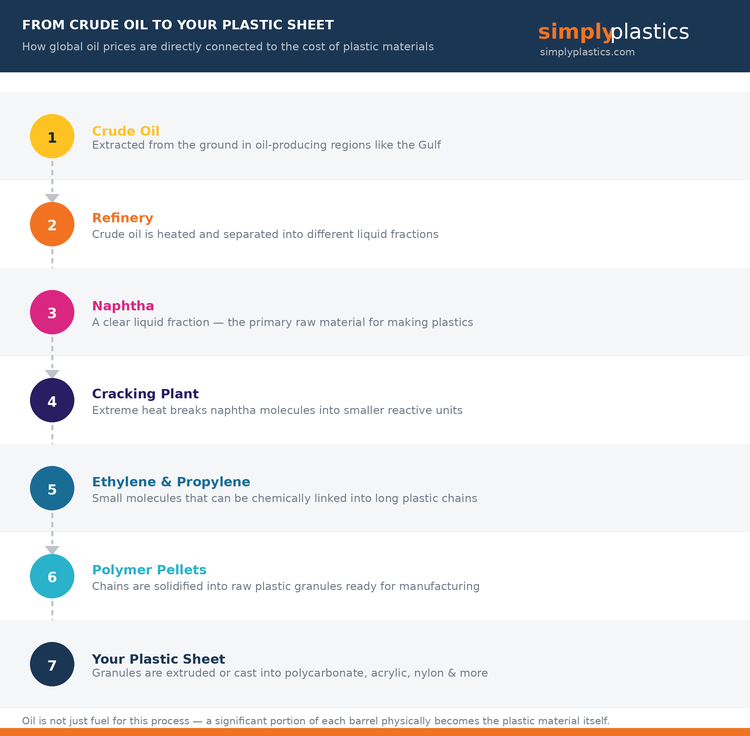
The connection between a barrel of oil and a sheet of polycarbonate isn't obvious, but it's very direct. It starts in a refinery, where crude oil is heated and separated into different liquid fractions — a bit like distilling whisky, where different components separate out at different temperatures. One of those fractions is called naphtha: a clear, volatile liquid that looks a little like petrol and is the primary raw material from which most plastics are made.
Naphtha goes into what's called a cracking plant — essentially a giant industrial furnace that uses extreme heat to break the naphtha molecules apart into much smaller ones. The two most important are ethylene and propylene. Think of them as the Lego bricks of the plastics industry: they're small, reactive molecules that can be chemically linked together in long chains to form the solid materials we recognise as plastic.
Those chains — polymers — are the raw plastic in granule form. From there, manufacturers melt and process them into sheets, rods, and tubes. The key point is that oil doesn't just power this process — a significant portion of each barrel physically becomes the material itself. So when the oil price moves, it moves the cost of the material directly.
Why the current crisis hits harder than a typical oil price rise
The closure of the Strait of Hormuz isn't a single price signal — it's applying pressure at several points in the chain simultaneously, and some of those effects are specific to plastics rather than just oil generally.
Qatar, one of the world's largest suppliers of LNG and naphtha, declared force majeure on gas contracts in early March and has halted production. Petrochemical plants across Asia that rely on Gulf naphtha supplies are already being forced to curtail polymer output. This means the raw plastic granule supply — before it even reaches sheet manufacturers — is tightening.
On top of that, energy costs are surging independently. The cracking and polymerisation processes are extremely energy-intensive, and with gas prices moving sharply alongside oil, the manufacturing cost base is being squeezed from two directions at once. Freight costs and insurance premiums for shipping through or around the region have also risen sharply, adding further cost to every tonne of material that reaches UK shores.
Which materials are most affected
Not all plastics respond equally to oil market pressure — it depends on how directly each material's chemical ingredients track the crude oil price.
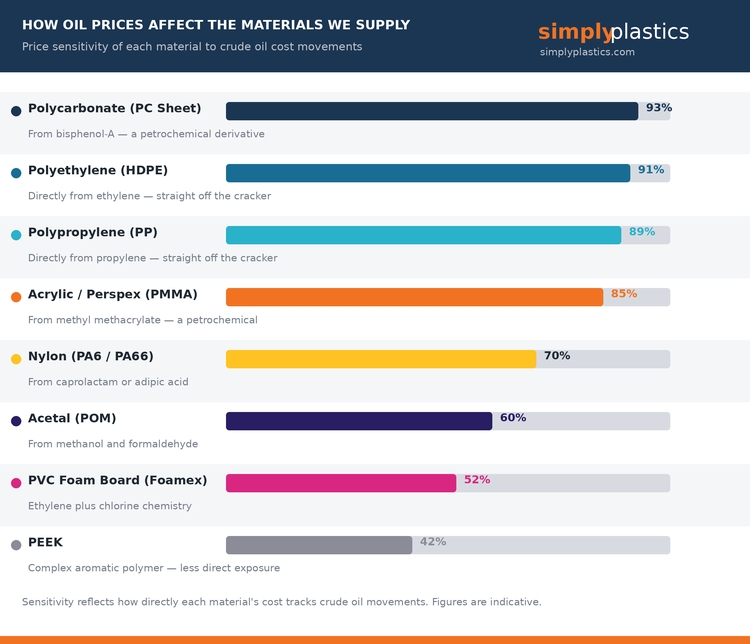
Polycarbonate, acrylic (Perspex), polyethylene, and polypropylene are all closely tied to naphtha and its derivatives, making them most sensitive to the current disruption. Nylon and acetal have more complex production routes but are still significantly affected. PVC Foamex has a partial dependence on chlorine chemistry which gives it slightly different dynamics, and PEEK — being a highly engineered specialist polymer — is somewhat more insulated from short-term crude swings, though not immune.
So what does all of this mean in practice if you're buying or specifying material right now?
How Simply Plastics can help protect your supply
The current situation is moving fast. Many major manufacturers are no longer guaranteeing supply until an order is placed, and quote validity has shortened — in some cases to as little as seven days. This means the risk isn't only about price; it's about availability too.
Our supply costs have risen significantly in a very short period. In response, we've taken three concrete steps:
We've committed to no price increases before 1st April. That gives you a clear window to place orders at current pricing, and we'd encourage you to use it for anything you have confirmed or in planning.
We're absorbing as much of the increase as we can. Where cost increases do need to be passed on, it will be only what we absolutely have to. We're not in the business of using a market disruption as cover for margin improvement.
We've significantly increased our stockholding. While manufacturer supply is uncertain, we've built up our own stock levels across core materials to give you as much continuity as possible.
We're hopeful this is a temporary situation and that prices will stabilise over the coming weeks and months. However, experience tells us that material prices tend to come down considerably more slowly than they go up — and it's only fair to be upfront about that.
Simply Plastics has always tried to be open, honest and fair with customers. That's why we've published this post well ahead of any price changes, rather than letting you find out when you next come to order.
What this means if you're buying or specifying material now
A few practical points worth keeping in mind in the current environment:
- Act on confirmed quotes promptly. In a fast-moving market, quote validity windows are shorter than usual. If you have a project confirmed, it's worth converting to an order sooner rather than later.
- Lead times may extend. If polymer output from Gulf producers continues to be curtailed, sheet availability across the industry will feel it within weeks. We hold strong stock across our core range, but unusual volumes or specialist grades may be affected.
- Talk to us about material options. If your application has some flexibility on grade or specification, there may be alternatives that do the same job with less exposure to current volatility. We're happy to advise.
Get in touch
Whether you need material for a project now or want to discuss upcoming requirements in the context of the current market, we'd rather you have the full picture than be caught out by prices that have moved since you last checked. Call us on 01206 638056 or get in touch through the website.
{{content.title}}
{{product.title}}
photo_size_select_smallCut to size
 {{product.colours}} Colours
{{product.description}}
{{product.fromText}}
{{product.fromText}}
Packing: {{product.packingDiagnostics.dimensions}} ({{product.packingDiagnostics.variants.length}})
| {{variant.name}} | {{variant.dimensions}} | {{variant.weight}} |