
Why Polycarbonate Is Replacing Glass in Modern Data Centres
Published on: 10/03/2026
Artificial intelligence, cloud computing and high-performance infrastructure are accelerating the expansion of data centres across the UK. The market is projected to grow at approximately 13% annually between 2025 and 2030 (Mordor Intelligence).

As facilities scale, energy use and operational efficiency are under increasing scrutiny. Data centres account for an estimated 2–3% of total UK electricity consumption, with cooling systems typically representing 30–40% of facility energy demand (Data Centre Review).
In this environment, material specification plays a direct role in safety, structural efficiency and thermal management.
Polycarbonate has long been specified within containment systems, cabinet panels and internal partitioning. This article explores why polycarbonate continues to be widely specified in modern data centre environments and how different sheet structures serve different functions.
Why Polycarbonate is Used in Data Centres
Polycarbonate, whether solid (monolithic) or multiwall structures such as twinwall, is widely specified in technical environments where durability, weight and visibility must be balanced.
Compared with traditional materials such as steel or glass, polycarbonate offers:
• High impact resistance (solid polycarbonate up to 200× stronger than glass)
• Lower weight, reducing structural load
• Corrosion resistance
• High light transmission
• Flame-retardant grades available (commonly UL94 rated)
• Ease of fabrication, machining and cut-to-size processing
These characteristics make it particularly suitable for data centre environments, where protection, inspection access and long-term stability are required.
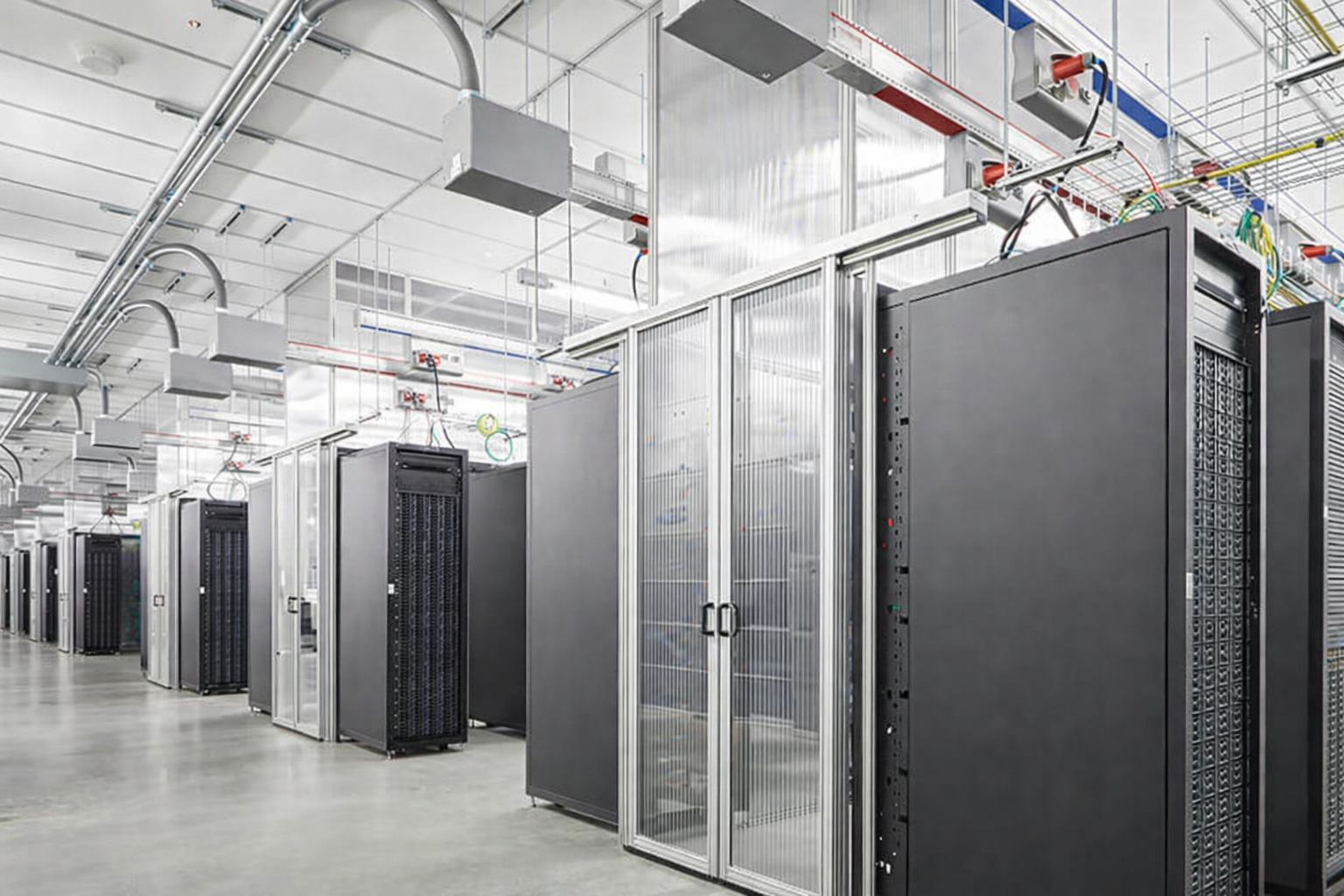
Polycarbonate panels are commonly used in data centre containment systems, including cabinet viewing panels, internal dividers, hot and cold aisle containment roofs and airflow partitions.
Solid, Twinwall and Multiwall Polycarbonate in Data Centre Applications
Solid, twinwall and multiwall polycarbonate sheets each serve distinct functions within data centre environments.
Solid (monolithic) polycarbonate provides high impact resistance and optical clarity, making it suitable for cabinet doors, viewing panels and security partitions where durability and transparency are important.
Twinwall polycarbonate incorporates internal fluted channels that significantly reduce weight while improving thermal performance. It is commonly specified for containment roofs and vertical airflow partitions, where lower structural loads and cost efficiency are beneficial.
Multiwall polycarbonate builds on this structure with additional internal layers, offering increased stiffness and lower U-values for larger spans or installations where improved thermal performance is required.
The comparison below highlights the key differences between common sheet types.
| Property | Solid (4mm) | Twinwall (10mm) | Multiwall (16mm) |
|---|---|---|---|
| Structure | Monolithic | Fluted | Multi-layer fluted |
| Approx. Weight | ~4.8 kg/m² | ~1.5 kg/m² | ~2.5 kg/m² |
| U-value | ~4.6 W/m²K | ~3.2 W/m²K | ~2.4 W/m²K |
| Light Transmission | ~89% | 75–80% | ~77% |
| Typical Use | Cabinet doors, security panels | Containment roofs, lightweight partitions | Larger-span containment panels |
Typical Applications in Data Centres
Polycarbonate sheets are commonly used throughout modern data centre infrastructure, particularly in containment and internal partitioning systems.
Typical applications include:
- Cabinet viewing panels
- Internal dividers
- Hot and cold aisle containment roofs
- Airflow partitions
- Protective barriers
- Lightweight shielding panels
The appropriate format depends on each location's performance requirements.
Solid polycarbonate remains a cornerstone material in data centre infrastructure where impact resistance and transparency are required. Twinwall and multiwall sheets provide lighter, thermally efficient alternatives for containment and partitioning applications where structural and impact demands differ.
Material Weight and Carbon Considerations
As data centres scale globally, sustainability and embodied carbon are becoming increasingly important considerations in material specification.
Compared with traditional materials such as glass, polycarbonate panels offer significant advantages in both transport efficiency and operational performance.
Polycarbonate sheets are substantially lighter than glass equivalents. A 4 mm polycarbonate sheet weighs approximately 4.8 kg per square metre, while comparable glazing panels can exceed 15 kg/m². Twinwall and multiwall sheets are lighter still, often weighing less than 2 kg/m².
This reduction in weight provides several practical benefits:
- Lower transport emissions due to more panels per delivery
- Reduced structural load requirements within containment systems
- Easier and safer installation on site
Operational efficiency is also a factor. Twinwall and multiwall polycarbonate incorporate internal air channels that improve insulation performance compared with monolithic materials.
When used in hot and cold aisle containment systems, this improved thermal separation can support more efficient airflow management and cooling performance.
While material selection alone does not determine a data centre’s energy footprint, lightweight thermally efficient panels can play a supporting role in reducing both embodied and operational carbon.
Key Specification Questions
When selecting polycarbonate panels for a data centre project, consider the following:
- Is the panel impact-exposed or security-critical?
- Is maximum transparency required?
- Is weight reduction important across large spans?
- Does the panel contribute to thermal separation?
- Is structural rigidity provided elsewhere in the system?
Answering these questions helps ensure the material specification is optimised for its environment.
Helping Deliver Data Centre Projects with Confidence
Simply Plastics has supported data centre installations for many years, supplying precision polycarbonate panels for containment systems, cabinet panels and technical environments.
Our large-format CNC machining capability allows us to manufacture panels with tight tolerances, ensuring components fit seamlessly into containment systems and structural frameworks. We also supply high-quality UK-certified materials, giving engineers and contractors confidence in performance and compliance.
If you're planning a data centre installation or upgrade, our team can help supply the polycarbonate panels required to keep your project on schedule and performing as intended.
Call 01206 638056 or email [email protected] to discuss your requirements.
Frequently asked questions
Polycarbonate sheet should not be cleaned using chemical cleaners because they can cause damage to the material. We recommend cleaning polycarbonate sheet with warm soapy water and a soft cloth. There are various plastic cleaners and polishers available which we can provide that keep polycarbonate looking brand new.
Generally speaking twinwall refers to a product that has just two walls, whereas multiwall refers to any polycarbonate sheeting that has more than two walls.
We offer Marlon ST Sheet in the thicknesses and wall structures below,
10mm - Twinwall
16mm - Triplewall
25mm - x7 wall
With proper care, twinwall/multiwall polycarbonate sheets should last in excess of 10 years. The polycarbonate we supply is guaranteed against discoloration for 10 years.
All of the different types of plastics that are available on our website, whether they be a panel, a disc, tube or rod, show the weight of the piece you require once you have entered your dimensions, shown in grams or kg.
The weight of any plastic can be calculated using the simple formula: Weight = Volume x Density
Read our blog post on how to calculate the weight of a variety of different plastics covering panels, discs, road and tube.
{{content.title}}
{{product.title}}
photo_size_select_smallCut to size
 {{product.colours}} Colours
{{product.description}}
{{product.fromText}}
{{product.fromText}}
Packing: {{product.packingDiagnostics.dimensions}} ({{product.packingDiagnostics.variants.length}})
| {{variant.name}} | {{variant.dimensions}} | {{variant.weight}} |