
How is the Hardness of Plastic Determined?
Published on: 23/03/2026
When selecting a plastic for a particular application, there are many material properties to consider — weight, chemical resistance, fire rating, and hardness among them. Yet hardness is one of the most misunderstood entries on a plastic datasheet, and is frequently confused with a related but very different property: toughness.
This post is the first in our Datasheets Demystified series, in which we explain what the numbers on your material datasheet actually mean — and why they matter when choosing the right plastic for your project.
Hardness vs Toughness — What's the Difference?
These two terms are often used interchangeably, but they refer to entirely different material behaviours.
Hardness is a material's ability to resist permanent surface deformation — including indentation, scratching, or cutting — when a force is applied.
Toughness is a material's ability to absorb energy and resist breaking when subjected to sudden forces, such as impacts, drops, or bending.
A practical example helps illustrate the distinction. Cast Acrylic is a harder material than Polycarbonate — it resists scratching and surface wear very well, making it ideal for signage and glazing where maintaining a clear, polished appearance matters. Polycarbonate, on the other hand, is far tougher — it can absorb significant impact without cracking or shattering, which is why it is the material of choice for applications such as riot shields, machine guards, and safety glazing.
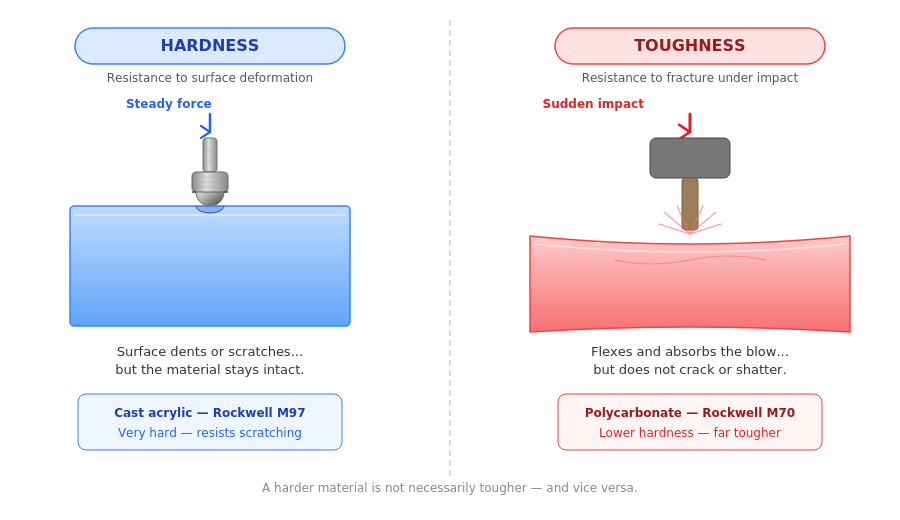
Neither material is inherently better. The right material depends entirely on the application's requirements.
What Affects the Hardness of a Plastic?
Plastic hardness — its resistance to scratches, dents, and surface wear — is influenced by several factors:
Molecular Structure: Crystalline, tightly packed polymers (such as HDPE and rigid PVC) tend to be harder. Amorphous polymers (such as acrylic and polycarbonate) are comparatively softer, though their other properties often make up for this.
Additives: Fillers, such as glass fibres, significantly increase hardness. Plasticisers, by contrast, are deliberately added to make plastics softer and more flexible — which is why flexible PVC feels so different to its rigid counterpart.
Processing Methods: The way a plastic is manufactured affects its final hardness. Slow cooling and controlled molecular orientation during production create harder, more structured materials. Rapid cooling results in a softer, less ordered structure.
Temperature: All plastics soften as the temperature rises and become harder (but more brittle) as it falls. This is worth bearing in mind if a material will be used in environments with significant temperature variation.
Environment and Ageing: UV light, moisture, and general wear can alter hardness over time — either softening a material or making it more brittle. This is one reason UV-stabilised grades exist for outdoor applications.
How is Hardness Measured?
This is where datasheets can seem intimidating — there are several different hardness scales, each designed for different material types and applications. Here are the three you are most likely to encounter for plastics.
Rockwell Hardness (R, M, L scales)
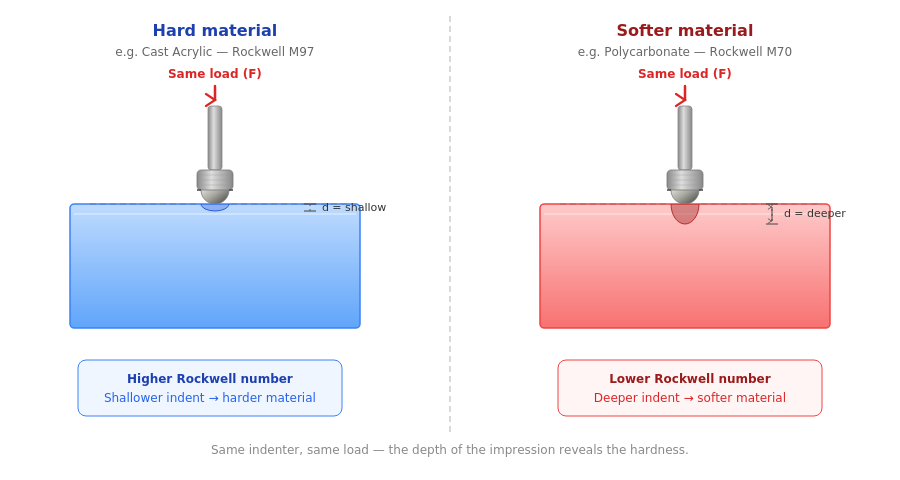
The Rockwell test works by pressing a steel ball into the surface of a material under a defined load, then measuring the depth of the indentation. The result is given as a Rockwell number on one of several scales — for plastics, the R scale (for softer materials like polyethylene) and the M scale (for harder plastics like acrylic and nylon) are most common.
A higher Rockwell number means greater hardness. Cast Acrylic typically registers around M97–M100, whereas Polycarbonate comes in at around M70–M75, which neatly explains why acrylic scratches less easily despite being the more brittle of the two.
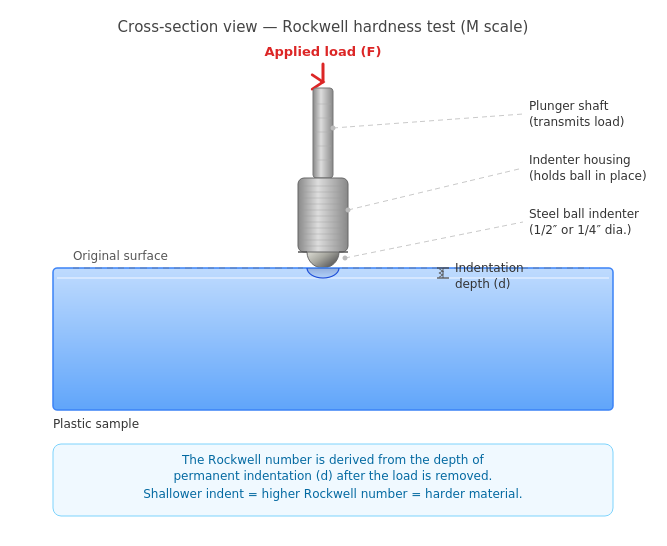
Rockwell hardness is the scale you will most commonly see on engineering plastic datasheets.
Shore Hardness (Shore D)
The Shore D scale uses a spring-loaded indenter pressed into a material's surface for a defined period of time. It is most commonly used for softer or more flexible plastics and elastomers. Shore D values run from 0 to 100, with higher numbers indicating a harder material.
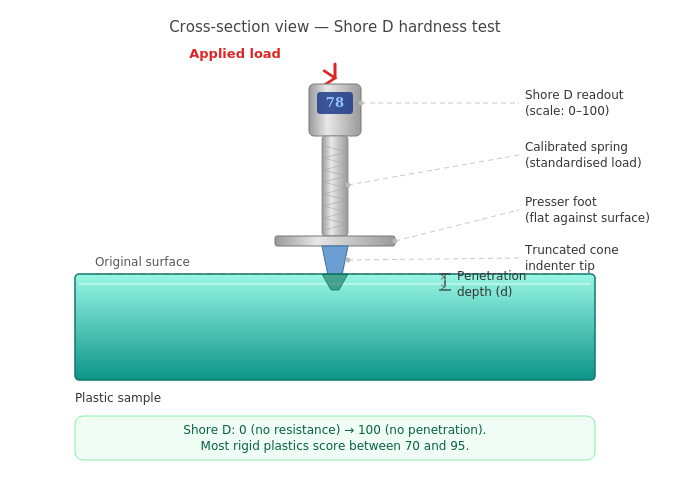
For reference, a standard PVC foam board (Foamex) will have a much lower Shore D value than a rigid engineering plastic. If you are working with flexible or semi-rigid materials, Shore D is likely the scale on your datasheet.
Vickers Hardness (HV)
The Vickers test uses a diamond pyramid indenter to create a very small indentation and measures the indentation's surface area under a microscope. It is more commonly associated with metals, but does appear on datasheets for some harder engineering plastics and composites.
Hardness of Common Plastics
The table below gives typical hardness values for the plastics we supply, to help you compare materials at a glance. Note that values can vary between grades and manufacturers — always refer to the specific datasheet for the material you are ordering.
| Material | Rockwell (M/R scale) | Shore D | Notes |
|---|---|---|---|
| Cast Acrylic (Perspex®) | M97–M105 | 80–90 | Hardest of the common sheet plastics; excellent scratch resistance |
| Extruded Acrylic | M90–M100 | 75-85 | Slightly softer than cast; see below |
| Polycarbonate | M70–M90 | 80–85 | Much tougher than acrylic despite lower hardness |
| PETG | R105–M115 | 70-80 | Good balance of hardness and impact resistance |
| Rigid PVC | M85–M90 | 80–85 | Good hardness; widely used in cladding and signage |
| HDPE | R60–R70 | 60–70 | Lower hardness; excellent chemical resistance |
| Nylon (PA6) | M82–M88 | 80-85 | Good wear resistance; used in engineering applications |
| Acetal (POM) | M80–M90 | 80–85 | Excellent wear and abrasion resistance |
| Polypropylene | R85–R100 | 65–75 | Moderate hardness; very good chemical resistance |
Cast vs Extruded Acrylic — A Hardness Perspective
There is ongoing debate in the plastics industry about whether cast or extruded acrylic is the better material, and that discussion usually centres on chemical resistance, machinability, or ease of forming. Hardness is often overlooked — but it is an important factor.
Cast acrylic is produced by polymerising a liquid monomer between glass moulds, a process that allows for higher-molecular-weight chains and a more uniform, tightly packed structure. This results in a measurably harder surface than extruded acrylic, which is produced by pushing molten material through a die at high speed—a process that is efficient and cost-effective but yields a slightly less ordered molecular structure.
In practice, this means cast acrylic resists scratching more effectively than extruded acrylic. For applications where the surface will be handled, cleaned regularly, or exposed to abrasion — such as display cases, signage, or picture frame glazing — cast acrylic will maintain its optical clarity for longer.
It is worth noting that neither variant is universally superior. Extruded acrylic offers tighter thickness tolerances, is generally more economical, and is better suited to certain forming operations. But if scratch resistance is a priority, cast acrylic is the stronger choice—and the hardness figures on the datasheet back this up.
We supply both cast acrylic and extruded acrylic cut to size, with real-time pricing available on our website.
Reading the Hardness Entry on Your Datasheet
When you download a datasheet from our website, the hardness entry will typically look something like this:
Hardness: Rockwell M97 / Shore D 87
Here is how to read it:
- Rockwell M97 — on the M scale (mid-range plastics), this material scores 97 out of a possible 130. This is a high value, indicating very good scratch and indentation resistance.
- Shore D 87 — on the Shore D scale (0–100), this is a high score, confirming the material is hard and rigid rather than flexible.
If you see only one scale listed, that is simply because it is the most appropriate test for that material type. Softer or flexible materials are more likely to be tested on the Shore D scale; rigid engineering plastics more commonly use Rockwell.
Summary
Hardness is a measure of a plastic's resistance to surface deformation, and it is a critical factor whenever scratch resistance, wear, or surface appearance matters in your application. The three scales you are most likely to encounter on a datasheet — Rockwell, Shore D, and Vickers — each measure hardness in a slightly different way, but all tell the same story: the higher the number, the harder the material.
If you are unsure which material is right for your project, our team is always happy to help. You can reach us on 01206 638056, email [email protected], or browse our full range and datasheets online.
Next in the Datasheets Demystified series: Impact Strength — what IK ratings and Charpy values really mean, and why toughness matters more than you might think.
Frequently asked questions
Yes we can. Customised, cut-to-size materials can be ordered directly through the website, but if you require further fabrication we can help you with this too.
Our fabrication services include,
- CNC routing
- Bending
- Shaping
- Bonding/gluing
- Diamond polishing
- Flame polishing
- Intricate laser cutting
Examples of fabricated products include,
- Acrylic display cases
- Point of sale
- Retail display
- Lighting applications
- Brochure holders
- 2D/3D Acrylic lettering
- Furniture
- Office Interiors
For enquiries regarding any project from prototypes to large production runs, please get in touch to discuss your requirements.
Acrylic is manufactured in two versions - cast and extruded. Cast acrylic is made by pouring the hot liquid acrylic ingredients between two sheets of glass which are separated by rubber gaskets - the thickness of the gasket determines the thickness of the acrylic sheet being made. The sealed glass plates are placed into an oven and allowed to heat during which the chemical processes and changes take place. Finally, the sheets are allowed to cool. Cast acrylic is commonly used for glazing, signage and retail displays. Extruded acrylic is made by pouring hot liquid acrylic ingredients into a form or die before the acrylic is forced through rollers which leaves the material with an even thickness and finish. Cast acrylic is generally regarded as a better quality material and offers a number of advantages over the extruded variant such as being more resistant to chemicals and solvents, less prone to scratching, easier to machine and fabricate and available in a far wider range of colours and surface finishes i.e. gloss/matte. Extruded acrylic is commonly used for lighting applications, interior decoration and screening.
Polycarbonate sheet can be cut using a circular saw, a jigsaw or any type of saw with a fine-tooth blade. We recommend laying the polycarbonate sheet flat on a firm surface, such as a workbench, and clamping it down before cutting. If you are using clamps to hold the material down, we suggest placing wood between the clamps and polycarbonate sheet to prevent any damage to the surface of the polycarbonate. Manufacturer safety precautions should always be followed when using any type of saw. See our ultimate guide to polycarbonate for more information on polycarbonate and it's uses.
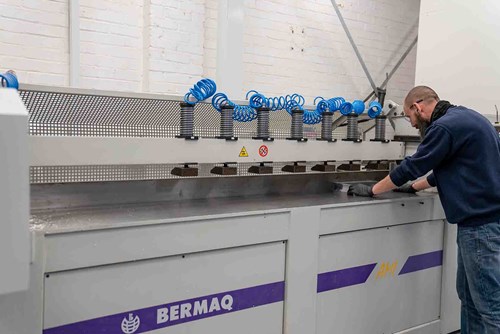
Within our plant we have 2 Bermaq Polishing machines, an AMI with a maximum polishing length of 2.5m plus the added facility to tilt the cutting head to achieve beveled edges and a Bermaq AM2 with a maximum polishing length of 1.25m. We also have three AquaFlame flame polishers. Finally we have a fully restored W Canning buffing/polishing wheel.
The photo below shows our Bermaq AMI being setup to polish a customers order.
Sanding, flame polishing and diamond polishing are all viable solutions for removing scratches on Perspex®. One point to be aware of is that diamond polishing removes material i.e. it cuts away a very small amount of material to achieve the polished edge, therefore if you want to remove scratches without affecting the dimensions of the part you should avoid diamond polishing. Another solution for removing light scratches and restoring shine is to use Osborn Unipol Plastic Polish.
When deciding whether Cast Acrylic or Extruded Acrylic is best for your project it’s worth considering the specific application and desired finish you hope to achieve. The table below provides some examples of the most suitable type of acrylic sheet to use for specific applications.
| Cast Acrylic | Extruded Acrylic | |
| Application |
|
|
In our experience, whilst some projects/applications will require specific characteristics of either Cast or Extruded Acrylic, in most cases the choice can be made based on either colour, thickness or cost, as below:
- Clear or Colour: Extruded acrylic is generally only manufactured in clear, black and white and therefore if there is a requirement for any other colour, Cast Acrylic is the only choice.
- Thickness: Cast acrylic is commonly manufactured in thicknesses up to 100mm whereas extruded is generally available in a maximum thickness of 20mm (Simply Plastics stock up to 50mm in Cast and 10mm in Extruded).
- Cost: Extruded is marginally cheaper and therefore any requirement for a large quantity of sheets/panels, where the benefits of cast acrylic are not important, is likely to be more cost effective produced in Extruded acrylic.
The main difference lies in how the material is manufactured. Nylon 6 Cast is stronger, tougher and has better wear resistance, whereas Nylon 6 Extruded is softer, easier to machine and more flexible.
PE300 and PE500 are different grades of polyethylene, with PE500 being a higher molecular weight version, meaning it offers greater wear resistance and impact strength compared to PE300. PE300 is easier to weld, offers a range of good properties and is a lower cost than PE500.
{{content.title}}
{{product.title}}
photo_size_select_smallCut to size
 {{product.colours}} Colours
{{product.description}}
{{product.fromText}}
{{product.fromText}}
Packing: {{product.packingDiagnostics.dimensions}} ({{product.packingDiagnostics.variants.length}})
| {{variant.name}} | {{variant.dimensions}} | {{variant.weight}} |